 MemphisJacqueline Smith, Lorraine Motel
Jacqueline Smith moved in to the Lorraine Hotel, a place where homeless people could live cheaply, in 1973, five years after the assignation of Dr Martin Luther king. The Lorraine hotel had been a place where homeless people lived and Jacqueline took a job there as a caretaker.
A keen supporter of Kings beliefs, she remained there for the next 15 years, sharing her studied knowledge of King with people who would come to the hotel to see his memorial. Jacqueline’s original desire to become an opera singer, her reason for leaving home had become overshadowed by her passion to explain and teach the words of King.
In the mid 1980’s it was decided that the hotel should become a museum, The Museum of Civil Rights, and from this point on people who resided there were asked to leave, and all did except for Jacqueline.
Jacqueline had strong objections about the hotel becoming a museum; she believed that this counter-acted Kings dreams and beliefs. She said that it should become a refuge, clinic, college, or something that would help the needy people of Memphis, and because of this Jacqueline refused to move out.
Eventually in 1988 Jacqueline was forcibly removed from the hotel by police and it was at this point that Jacqueline walked across the street from where King had been shot, sat on a bench, and refused to move.
Jacqueline, at the date of this email, has been sat there for 25 years, 6 days.
She survives on donated items of food, clothing, makeshift shelter and so forth from her supporters.
I first encountered Jacqueline Monday morning, the12th July 2012, a morning much as any other for Jacqueline. I had not gone looking for her, but to see the place where Martin Luther King was assassinated and visit the museum.
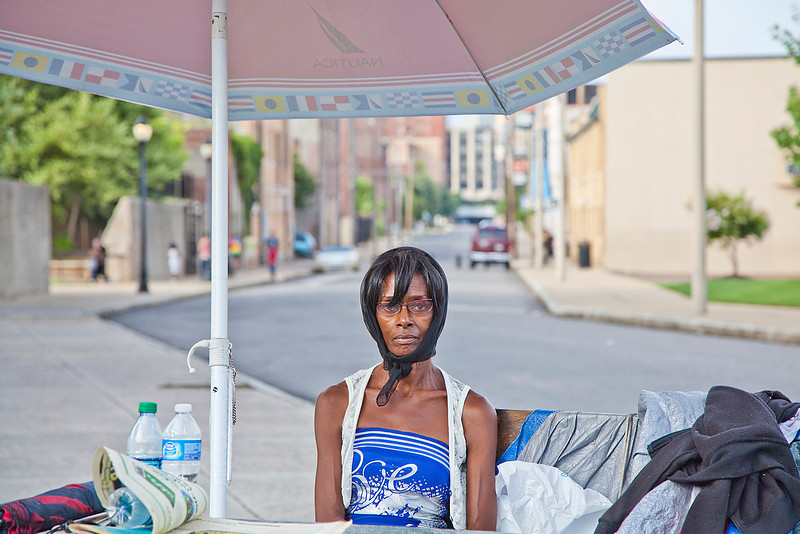
I did not know who she was or why she was there, but I was captured by the look of the woman who appeared to be from another place and time sitting on this Memphis Street. Her appearance is circa to 1960’s; Jacqueline is living in a time warp since the days of Martin Luther King.
I decided to talk to her and I as I approached her she asked where I was from, I said England. Jacqueline said English are all racists because her friend moved there and someone killed her cat because she was black. She would not allow me to take her picture; people around had started to move away because of her comments to me on racism. I asked if I could give her money to take her picture, she said yes. Jacqueline was very much in control and was determined to dictate the picture; she wanted to hold a poster up of Martin Luther King in the picture, I managed to take a few shots, here are some of them, see attachments.
She asked me more questions but refused to accept questions from me, only ever responding with quotes from King.
I returned to my hotel and did some research on Jacqueline Smith. I found it hard to believe that really was there 24/7 for all those years. I decided to go back there about 10pm and there she was, in a totally different setting. Gone was the hustle and bustle of the famous street, and with the emptiness, silence and the cold of the night I met a completely different woman. I said hello and she greeted me, remembering me from earlier. I asked if she was going to sleep there and she said yes, she did so every night, summer when she gets bitten by insects and winter, when it’s cold. She told me she is afraid at night when people come out of the clubs she said there have been incidents over the years. She was evidently a very vulnerable woman at night, as opposed to the quite fearsome protestor that she was in the day. I did not photograph her at night, I did not ask, it seemed to invasive. We talked about anything she clearly did not want me to go, appearing quiet desperate for company.
Jacqueline told me that she feels angry about the content of Civil Rights Museum, although amazingly she has never set foot inside. She has read and been told about its content and is worried that racism in being bred by what visitors see. Having been inside I can feel empathy with her statement. Her comment relates to all racism, not just against black people. As a white woman I felt a sense of deep shame and responsibility, but the presence of many black visitors around me presented a situation of high tension. It would easy as a white person to feel victimised in this setting.
The white human is depicted as the perpetrator of racism. Slavery, Ku Klux Klan, uprising of black low paid manual workers, the Rosa Parks incident, then the story of Martin Luther King. Jacqueline says that this would not please King, he fought to extinguish racism and he would not want these stark reminders associated with his name.
Since driving away from Memphis almost a year ago I don’t think a day has passed when I have not thought about Jacqueline Smith sitting on her bench. It could be said that she is as much of an institution as the museum itself.
You have to respect a woman who continually puts herself through this for her beliefs and those of a man she studied and respected.
“Dr Martin Luther king came to the Lorraine Hotel to support the disadvantaged, not to preach hatred” Jacqueline Smith.
Jacqueline Smith moved in to the Lorraine Hotel, a place where homeless people could live cheaply, in 1973, five years after the assignation of Dr Martin Luther king. The Lorraine hotel had been a place where homeless people lived and Jacqueline took a job there as a caretaker.
A keen supporter of Kings beliefs, she remained there for the next 15 years, sharing her studied knowledge of King with people who would come to the hotel to see his memorial. Jacqueline’s original desire to become an opera singer, her reason for leaving home had become overshadowed by her passion to explain and teach the words of King.
In the mid 1980’s it was decided that the hotel should become a museum, The Museum of Civil Rights, and from this point on people who resided there were asked to leave, and all did except for Jacqueline.
Jacqueline had strong objections about the hotel becoming a museum; she believed that this counter-acted Kings dreams and beliefs. She said that it should become a refuge, clinic, college, or something that would help the needy people of Memphis, and because of this Jacqueline refused to move out.
Eventually in 1988 Jacqueline was forcibly removed from the hotel by police and it was at this point that Jacqueline walked across the street from where King had been shot, sat on a bench, and refused to move.
Jacqueline, at the date of this email, has been sat there for 25 years, 6 days.
She survives on donated items of food, clothing, makeshift shelter and so forth from her supporters.
I first encountered Jacqueline Monday morning, the12th July 2012, a morning much as any other for Jacqueline. I had not gone looking for her, but to see the place where Martin Luther King was assassinated and visit the museum.
I did not know who she was or why she was there, but I was captured by the look of the woman who appeared to be from another place and time sitting on this Memphis Street. Her appearance is circa to 1960’s; Jacqueline is living in a time warp since the days of Martin Luther King.
I decided to talk to her and I as I approached her she asked where I was from, I said England. Jacqueline said English are all racists because her friend moved there and someone killed her cat because she was black. She would not allow me to take her picture; people around had started to move away because of her comments to me on racism. I asked if I could take her picture and after some persuasion she said yes. Jacqueline was very much in control and was determined to dictate the picture; she wanted to hold a poster up of Martin Luther King in the picture and I managed to take a few shots.
She asked me more questions but refused to accept questions from me, only ever responding with quotes from King.
I returned to my hotel and did some research on Jacqueline Smith. I found it hard to believe that really was there 24/7 for all those years. I decided to go back there about 10pm and there she was, in a totally different setting. Gone was the hustle and bustle of the famous street, and with the emptiness, silence and the cold of the night I met a completely different woman. I said hello and she greeted me, remembering me from earlier. I asked if she was going to sleep there and she said yes, she did so every night, summer when she gets bitten by insects and winter, when it’s cold. She told me she is afraid at night when people come out of the clubs she said there have been incidents over the years. She was evidently a very vulnerable woman at night, as opposed to the quite fearsome protestor that she was in the day. I did not photograph her at night, I did not ask, it seemed to invasive. We talked about anything she clearly did not want me to go, appearing quiet desperate for company.
Jacqueline told me that she feels angry about the content of Civil Rights Museum, although amazingly she has never set foot inside. She has read and been told about its content and is worried that racism in being bred by what visitors see. Having been inside I can feel empathy with her statement. Her comment relates to all racism, not just against black people. As a white woman I felt a sense of deep shame and responsibility, but the presence of many black visitors around me presented a situation of high tension. It would be easy as a white person to feel victimised in this setting.
The white human is depicted as the perpetrator of racism. Slavery, Ku Klux Klan, uprising of black low paid manual workers, the Rosa Parks incident, then the story of Martin Luther King. Jacqueline says that this would not please King, he fought to extinguish racism and he would not want these stark reminders associated with his name.
Since driving away from Memphis almost a year ago I don’t think a day has passed when I have not thought about Jacqueline Smith sitting on her bench. It could be said that she is as much of an institution as the museum itself.
You have to respect a woman who continually puts herself through this for her beliefs and those of a man she studied and respected.
“Dr Martin Luther king came to the Lorraine Hotel to support the disadvantaged, not to preach hatred” Jacqueline Smith.
By Jayne Haywood.